
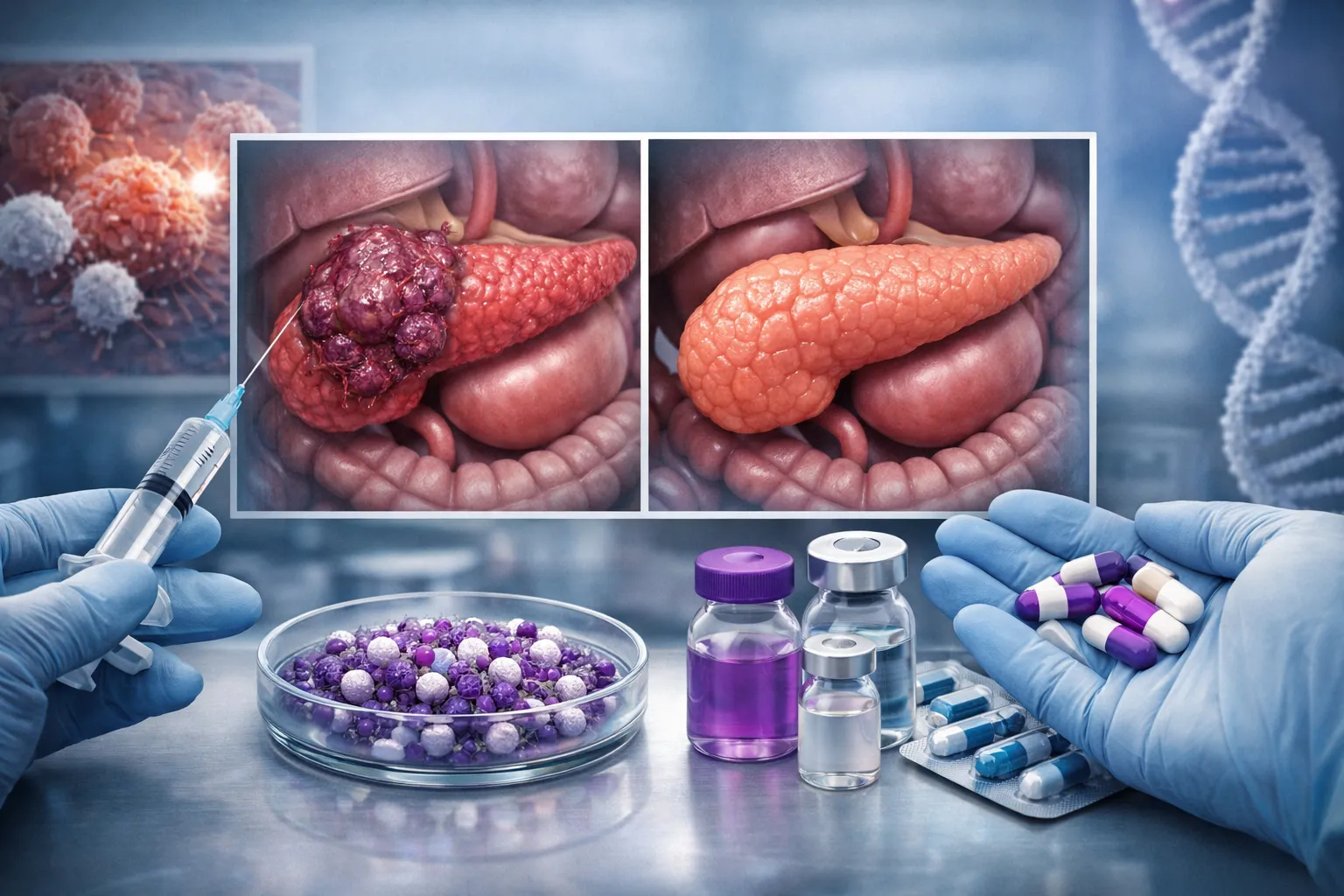
Researchers have announced a promising development in the fight against one of the deadliest forms of cancer. A new experimental treatment targeting Pancreatic cancer has shown the ability to eliminate tumors in early laboratory studies while also preventing the disease from developing resistance to therapy.
This discovery has generated strong interest among scientists and medical experts because pancreatic cancer has long been considered one of the most difficult cancers to treat. Many patients are diagnosed at an advanced stage, and current therapies often lose effectiveness as tumors adapt to the drugs used against them.
The new approach aims to tackle both problems at once: destroying cancer cells and blocking the mechanisms that typically allow tumors to survive treatment.
Why pancreatic cancer is so difficult to treat
Pancreatic cancer remains one of the most challenging cancers for doctors worldwide. Unlike many other cancers, it often develops silently without obvious symptoms during its early stages.
By the time the disease is detected, the tumor has frequently already spread to nearby tissues or other organs. This late diagnosis significantly reduces the chances of successful treatment.
Another major challenge is drug resistance. Cancer cells have an extraordinary ability to adapt to therapies designed to destroy them. Over time, treatments that initially shrink tumors can become less effective as the cancer evolves.
Standard treatments may include surgery, radiation therapy, and chemotherapy drugs such as Gemcitabine. While these methods can slow the disease, long-term control remains difficult.
This is why researchers have been searching for new strategies capable of targeting pancreatic tumors more effectively.
A new strategy targeting tumor survival mechanisms
The new treatment being studied focuses on disrupting the biological systems that allow cancer cells to survive and multiply. Instead of targeting only the tumor itself, scientists are working to interfere with the pathways that help cancer cells repair damage caused by treatment.
By blocking these survival mechanisms, the therapy makes tumor cells far more vulnerable to destruction.
In early studies conducted on laboratory models, researchers observed that tumors treated with the experimental therapy were significantly reduced or completely eliminated. Even more importantly, the cancer cells did not develop the typical resistance that often emerges with traditional chemotherapy.
This dual effect—destroying tumors while preventing resistance—could represent a major step forward in cancer treatment.
How the treatment works
The new therapy uses a targeted approach designed to attack specific molecular processes inside cancer cells. Many tumors rely on certain proteins and signaling pathways to repair DNA damage and continue growing.
The experimental treatment blocks these pathways, leaving cancer cells unable to recover after being exposed to therapy.
As a result, the tumor cells gradually lose their ability to survive. In preclinical studies, scientists observed that the cancer cells began to die off rather than adapting to the treatment.
Researchers believe this strategy may also enhance the effectiveness of existing therapies, potentially allowing doctors to combine the new approach with chemotherapy or other targeted treatments.
If future studies confirm these findings, the treatment could offer a powerful new option for patients diagnosed with pancreatic cancer.
Early results raise cautious optimism
Although the research is still in its early stages, the results have generated cautious optimism within the scientific community.
Laboratory studies have shown that the treatment can significantly shrink tumors in experimental models. Even after repeated exposure, the tumors did not appear to develop resistance to the therapy.
This is particularly important because drug resistance is one of the biggest reasons cancer treatments eventually stop working.
Experts emphasize that additional research and clinical trials will be necessary before the treatment can be used in hospitals. However, the early data suggest that the therapy could potentially improve outcomes for patients facing this aggressive disease.
For families affected by pancreatic cancer, even incremental advances in treatment can make a meaningful difference.
What this could mean for future cancer treatments
If confirmed in clinical trials, this discovery could influence how doctors approach not only pancreatic cancer but also other difficult-to-treat tumors.
Many cancers share similar survival mechanisms that allow them to resist treatment. By targeting these pathways directly, scientists may be able to design therapies that remain effective for longer periods.
The research also reflects a broader shift in oncology toward precision medicine—treatments designed to attack specific biological features of cancer cells rather than relying solely on general chemotherapy.
Organizations such as the National Cancer Institute and major medical research centers around the world are increasingly focusing on these types of targeted therapies.
While significant work remains before such treatments become widely available, the direction of the research offers renewed hope.
The road ahead for clinical trials
Before the therapy can reach patients, it must undergo several phases of clinical testing to ensure that it is both safe and effective.
Clinical trials typically begin with small groups of participants to evaluate safety and dosage levels. Later stages involve larger groups of patients to determine how well the treatment works compared with existing therapies.
If the results remain positive, the therapy could eventually become part of standard treatment options for pancreatic cancer.
Researchers caution that medical breakthroughs often require years of testing and refinement. However, each discovery adds valuable knowledge that helps scientists move closer to more effective cancer therapies.
For a disease as difficult as pancreatic cancer, innovative strategies like this one represent an important step forward in the ongoing effort to improve survival rates and quality of life for patients.