
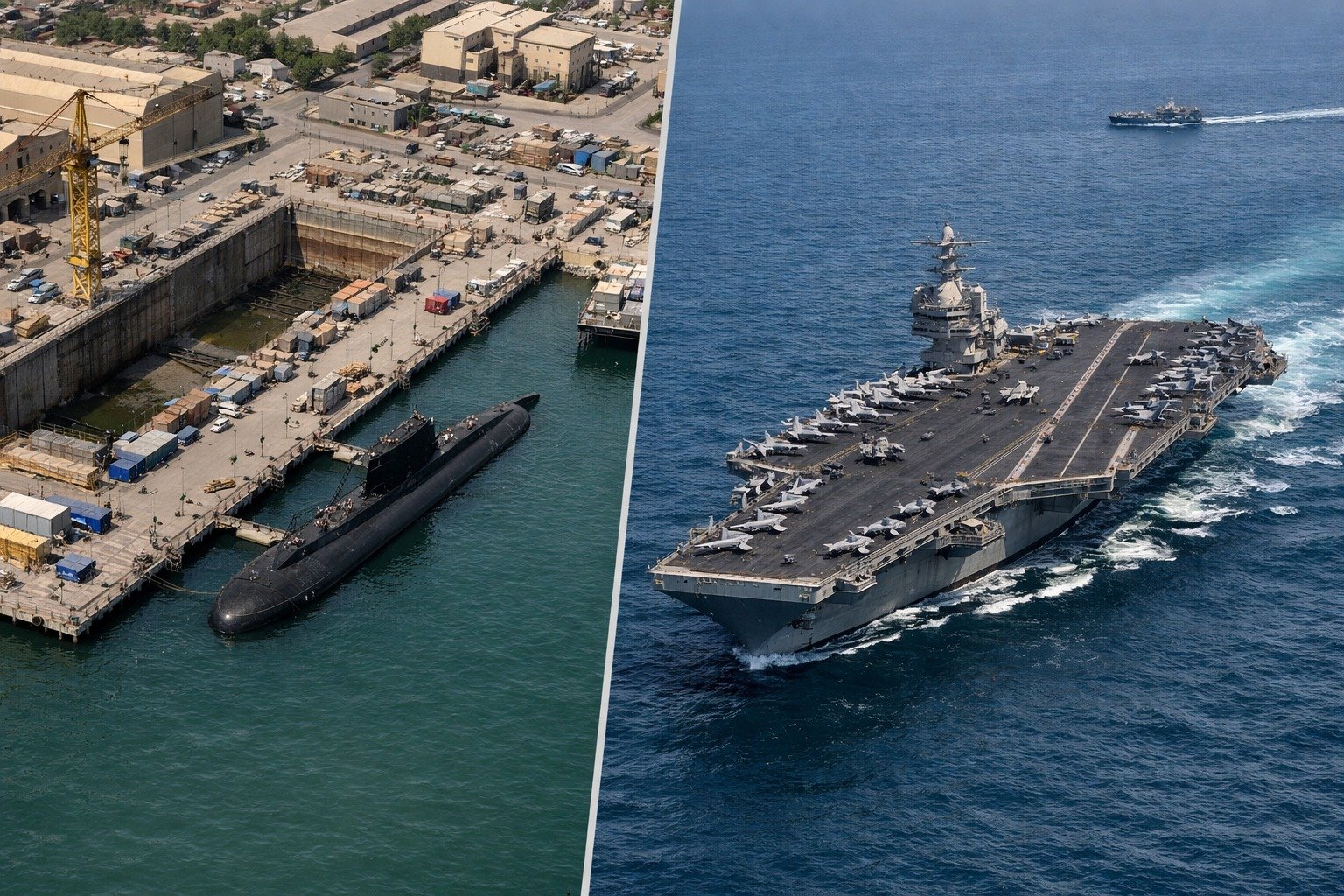
Recent satellite imagery has revealed that Iran has returned one of its Russian-built Kilo-class submarines to operational service after spending months in dry dock for maintenance and possible upgrades. The development comes at a time when the United States is increasing its military presence in the Middle East, including the deployment of the powerful aircraft carrier USS Gerald R. Ford and its strike group.
Defense analysts say the timing of these developments has drawn attention because both countries appear to be reinforcing their naval capabilities around the Persian Gulf, one of the world’s most strategically important waterways.
Although naval movements and military exercises occur frequently in the region, the return of an Iranian submarine to active service alongside the arrival of a U.S. carrier group highlights the complex balance of power that defines security in the Gulf.
Satellite Images Reveal Submarine Back at Base
Open-source satellite images analyzed by military observers appear to show one of Iran’s Kilo-class submarines docked again at its naval facility near Bandar Abbas.
The vessel had reportedly spent several months in dry dock undergoing repairs, maintenance work, and possible modernization efforts. During such overhauls, naval engineers often inspect propulsion systems, sonar equipment, and onboard electronics to extend the operational life of the submarine.
In the latest imagery, the submarine can be seen moored at its pier alongside smaller patrol vessels and support ships. Analysts believe the submarine has now returned to operational readiness and could soon resume patrol duties in nearby waters.
Iran operates only a limited number of these larger submarines, which makes them particularly valuable within the country’s naval strategy.
What Makes the Kilo-Class Submarine Important
The Kilo-class submarine is a diesel-electric attack submarine originally developed by the Soviet Union during the late Cold War. The vessels were designed to operate quietly underwater, making them difficult for enemy ships and aircraft to detect.
Because of their stealth, Western naval analysts often refer to these submarines as “black hole” vessels due to their ability to remain hidden in coastal waters.
Iran acquired several Kilo-class submarines from Russia during the 1990s, and they continue to represent some of the most capable platforms in the Iranian navy.
These submarines are typically equipped with torpedoes and naval mines and can be used for patrol missions, reconnaissance, and defensive operations. Compared with Iran’s domestically produced mini-submarines, the Kilo vessels provide greater endurance, range, and firepower.
Their return to service therefore strengthens Iran’s underwater presence in the region.
Why the Persian Gulf Is Strategically Important
The Persian Gulf remains one of the most strategically important maritime areas in the world.
At the eastern end of the Gulf lies the Strait of Hormuz, a narrow waterway that connects the Gulf to the Arabian Sea. A significant portion of the world’s oil shipments travels through this passage each day.
Because global energy supplies depend heavily on this route, the area is closely monitored by military forces from multiple countries.
The United States and its allies frequently conduct patrols and naval exercises in the region to ensure the security of international shipping lanes.
At the same time, Iran maintains extensive coastal defenses, including missile systems, patrol boats, and naval bases designed to protect its shoreline and influence regional waters.
Arrival of the USS Gerald R. Ford
While Iran’s submarine appears to be returning to service, the United States has also been strengthening its naval presence in the region.
Among the most notable deployments is the aircraft carrier USS Gerald R. Ford, the newest and most technologically advanced carrier in the U.S. Navy.
The carrier serves as the centerpiece of a carrier strike group, which includes guided-missile destroyers, cruisers, and support vessels. Together, these ships can project significant air and naval power across vast distances.
The Gerald R. Ford is capable of launching dozens of aircraft and supporting a wide range of operations, including surveillance, deterrence, and combat missions.
Deploying such a carrier group often signals heightened readiness during periods of regional tension.
Increasing Naval Activity in the Region
With Iran operating submarines and the United States deploying carrier strike groups, the waters around the Persian Gulf are becoming increasingly busy.
Naval forces from various countries routinely operate in the area, conducting patrols, joint exercises, and maritime security missions.
In such a crowded environment, maintaining communication and coordination between naval forces becomes especially important to avoid misunderstandings or accidental encounters.
Submarines add an additional challenge because they operate underwater and are difficult to detect.
As a result, many navies in the region rely heavily on anti-submarine warfare technologies, including sonar systems, maritime patrol aircraft, and specialized detection equipment.
Iran’s Focus on Asymmetric Naval Strategy
Iran’s naval strategy is often described as asymmetric warfare, meaning it focuses on using smaller or unconventional forces to counter larger military powers.
Alongside its Kilo-class submarines, Iran operates fleets of fast-attack boats, coastal missile systems, and smaller submarines designed to operate in shallow waters.
These forces are particularly suited to the geography of the Gulf, where narrow waterways and busy shipping lanes can create tactical advantages for smaller vessels.
Submarines play an important role in this strategy because they can remain hidden underwater and threaten larger ships with torpedoes or mines if necessary.
Maintaining operational submarines is therefore a key priority for Iran’s navy.
Satellite Technology Revealing Military Movements
Much of the information about these developments comes from commercial satellite imagery and open-source intelligence.
Modern satellites can capture highly detailed images of military bases, naval ports, and ships at sea. Analysts often compare images taken at different times to detect changes in military activity.
Through these comparisons, experts can identify when ships leave port, when infrastructure expands, or when equipment returns to service after repairs.
The satellite images showing Iran’s submarine back at its base demonstrate how widely available technology is transforming the way global military developments are monitored.
A Region Under Constant Observation
The return of an Iranian submarine to service and the deployment of a major U.S. carrier group illustrate how closely watched the Persian Gulf remains.
Although such movements do not necessarily indicate an immediate conflict, they show how rapidly the strategic landscape can shift in a region that plays a crucial role in global energy supply and international security.
Governments, analysts, and military observers around the world continue to monitor developments in the Gulf carefully.
As long as the region remains a central hub for global trade and energy transport, the presence of submarines, aircraft carriers, and other naval forces will continue to draw international attention.