
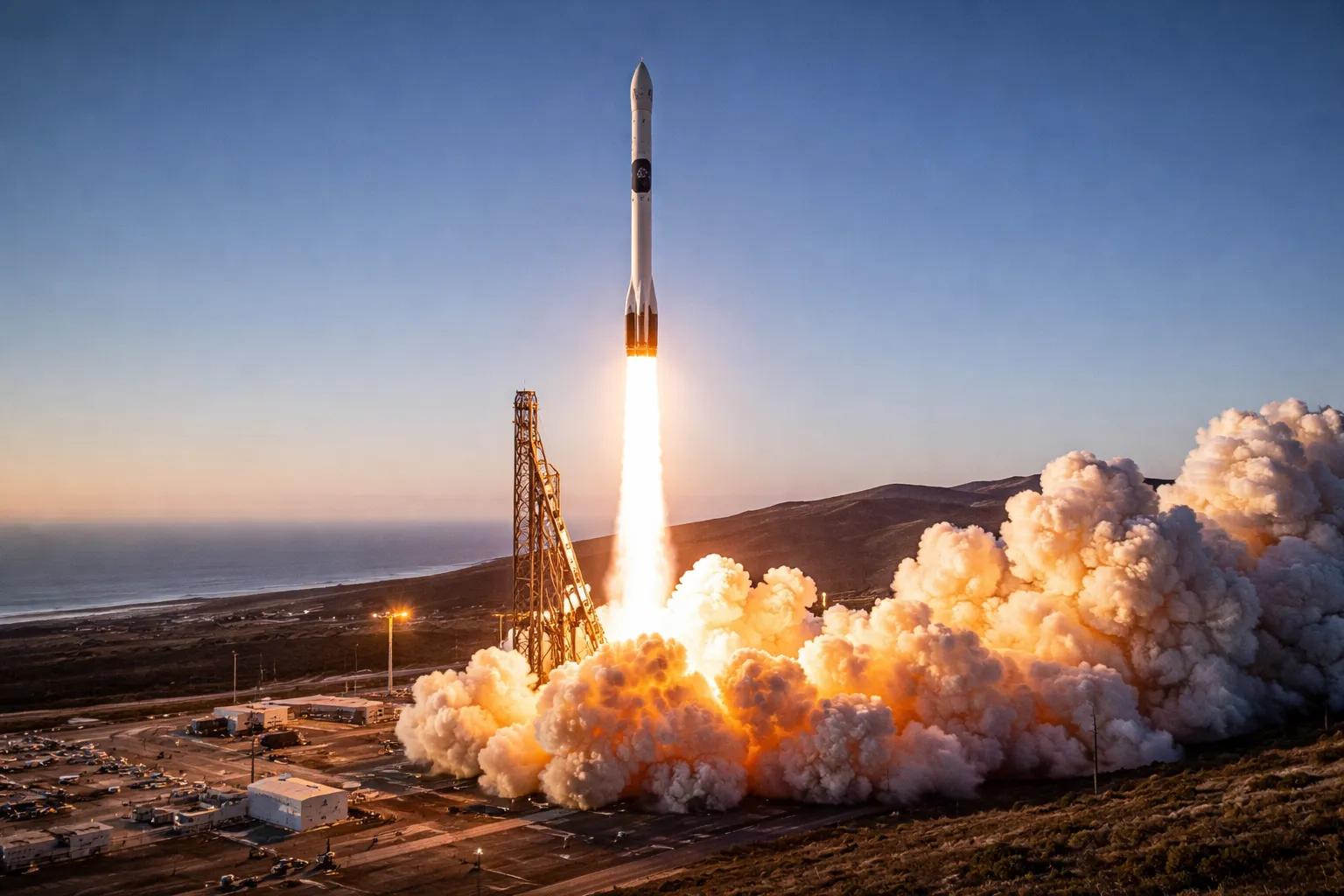
A Falcon 9 rocket successfully launched 25 Starlink satellites into orbit from California, continuing the rapid expansion of SpaceX’s global satellite internet network. The launch took place from Vandenberg Space Force Base, one of the company’s primary West Coast launch sites, and marked another step toward building a massive constellation designed to provide high-speed internet access across the planet.
As the Falcon 9 lifted off from the California coast, it carried a fresh batch of Starlink satellites into low Earth orbit. The mission followed a carefully choreographed sequence lasting just over an hour, from liftoff to satellite deployment. Each launch helps strengthen SpaceX’s goal of delivering reliable internet service to remote regions and underserved communities worldwide.
Liftoff from California’s Vandenberg Base
The launch began at Vandenberg Space Force Base, located along California’s central coast. This site allows SpaceX to send rockets into polar orbits, which are particularly useful for deploying satellites that need to cover the entire globe.
At liftoff, the Falcon 9 rocket’s nine Merlin engines ignited simultaneously, producing more than 1.7 million pounds of thrust. The rocket quickly climbed through the morning sky, leaving behind a bright trail visible along the coastline.
Within the first few minutes, the rocket passed through maximum aerodynamic pressure, a critical phase when the vehicle experiences the strongest forces during ascent. After this point, the Falcon 9 continued accelerating toward space, carrying the Starlink satellites aboard its payload fairing.
First Stage Booster Returns to Earth
One of the most remarkable aspects of every Falcon 9 launch is the rocket’s reusable first stage. After separating from the upper stage roughly two and a half minutes after liftoff, the booster began its journey back toward Earth.
The booster performed a series of carefully timed engine burns to guide itself back to a drone ship stationed in the Pacific Ocean. These autonomous landing ships allow SpaceX to recover rockets even during missions that require significant fuel to reach orbit.
As the booster descended, it reignited its engines to slow its speed before landing vertically on the drone ship. This controlled landing enables the rocket to be refurbished and reused for future launches, dramatically reducing the cost of spaceflight.
Upper Stage Continues the Mission
While the first stage returned to Earth, the Falcon 9’s upper stage continued the mission.
Powered by a single Merlin vacuum engine, the upper stage carried the 25 Starlink satellites into low Earth orbit. This phase of the flight lasted several minutes as the rocket accelerated to orbital velocity, reaching speeds of roughly 17,500 miles per hour.
Once the initial orbit was achieved, the upper stage coasted through space before performing a second engine burn. This maneuver positioned the spacecraft at the correct altitude and orientation for satellite deployment.
Deploying 25 Starlink Satellites
About an hour after liftoff, the Falcon 9 began releasing the 25 Starlink satellites into orbit.
The satellites were deployed in a controlled sequence, gently separating from the rocket’s payload adapter. After deployment, each satellite began activating its onboard systems and extending its solar panels.
These satellites are designed to maneuver into their designated orbital positions using electric propulsion systems. Over the following days and weeks, they will gradually spread out along their orbital paths to join the existing Starlink network.
The deployment marks the completion of the rocket’s primary mission.
What the Starlink Satellites Do
Starlink is SpaceX’s satellite-based internet service, designed to provide high-speed broadband access almost anywhere on Earth.
Unlike traditional internet satellites that operate in high geostationary orbit, Starlink satellites fly much closer to Earth in low Earth orbit. This lower altitude significantly reduces signal delay, allowing users to experience faster and more responsive internet connections.
Each satellite communicates with ground stations and user terminals to deliver internet service. The growing constellation allows signals to hop between satellites, ensuring coverage even in remote regions.
With each new launch, the network becomes more capable of handling increased demand and delivering consistent service.
Expanding a Massive Satellite Constellation
SpaceX has already launched thousands of Starlink satellites, making it the largest satellite constellation ever built.
The company continues to conduct regular launches to expand and refresh the network. Some satellites replace older units, while others add capacity and extend coverage.
The goal is to create a system capable of supporting millions of users worldwide. This includes people living in rural areas, ships at sea, aircraft in flight, and communities that previously lacked reliable internet access.
Future upgrades to the Starlink system may also include improved satellites with advanced communication technologies.
Impact on Global Connectivity
The rapid expansion of the Starlink network has begun to transform how people connect to the internet.
In regions where fiber cables or traditional infrastructure are difficult to install, satellite internet offers an alternative solution. This technology can support education, business, telemedicine, and emergency communication in places that were previously underserved.
Governments, humanitarian organizations, and private companies have also explored using Starlink to provide connectivity during natural disasters or infrastructure outages.
As the constellation grows, the network’s speed and reliability are expected to improve further.
Looking Ahead to Future Launches
The successful launch of 25 Starlink satellites from California highlights the efficiency of SpaceX’s launch operations.
Falcon 9 rockets now launch multiple times each month, carrying satellites, scientific payloads, and cargo missions to space. Each flight demonstrates the growing capability of reusable rocket technology.
With dozens of additional Starlink launches planned in the coming months, the constellation will continue expanding rapidly.
For SpaceX, every mission brings the company closer to its long-term vision of a fully connected planet, where reliable internet access is available almost anywhere on Earth.