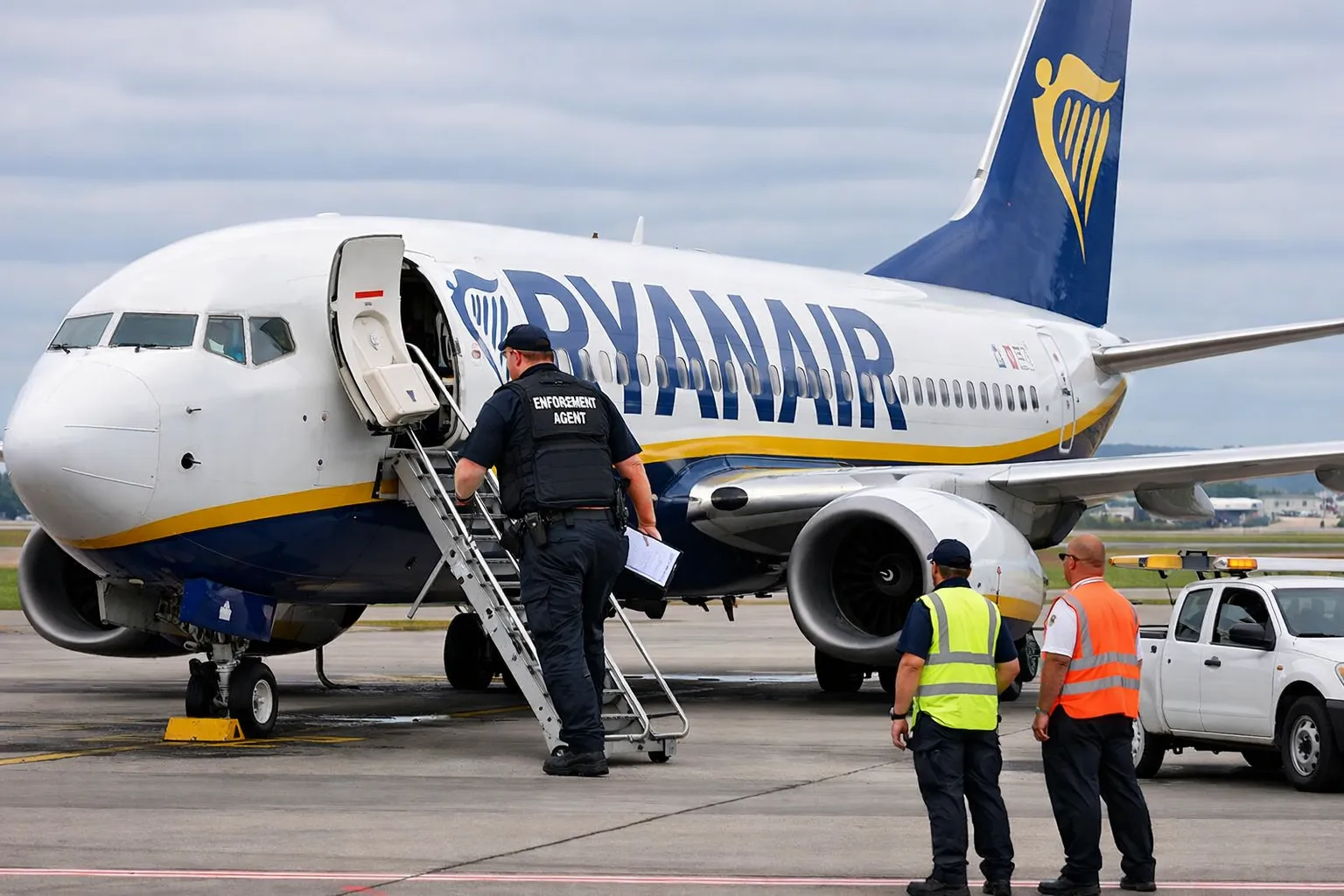
A routine airline delay turned into an extraordinary legal confrontation when a passenger sought compensation after a disrupted flight. The case, involving the well-known low-cost airline Ryanair, ultimately escalated to the point where a court-appointed bailiff boarded a plane and ordered it temporarily seized.
The dispute began with what initially appeared to be a typical compensation claim following a delayed flight. However, when the airline allegedly refused to pay the amount ordered by the court, legal enforcement authorities intervened in an unusual way.
The result was a scene rarely witnessed in commercial aviation: a bailiff boarding a Boeing 737 to enforce a court ruling worth just over $1,000.
The original delay that started the case
The story began when a passenger experienced a significant delay on a flight operated by Ryanair. Under European air passenger protection laws, travelers are entitled to compensation when flights are delayed for several hours and the disruption falls within the airline’s responsibility.
These protections come from EU Regulation 261/2004, which establishes standardized compensation for delayed or cancelled flights within the European Union.
Depending on the distance of the journey and the length of the delay, passengers can receive compensation ranging from a few hundred to more than a thousand dollars.
In this case, the passenger claimed compensation of approximately $1,182, an amount consistent with the rules governing long delays under European law.
When the airline reportedly refused to pay the compensation voluntarily, the passenger decided to pursue the matter through legal channels.
A court ruling in favor of the passenger
After reviewing the case, a court ruled that the passenger was indeed entitled to compensation under EU Regulation 261/2004.
The ruling ordered Ryanair to pay the amount owed. In most situations, airlines comply with such decisions and settle the payment without further complications.
However, according to reports surrounding the case, the compensation was not paid within the expected timeframe.
When a court judgment is not respected, the legal system provides mechanisms to enforce the decision. In many countries, this responsibility falls to a bailiff who has the authority to seize assets belonging to the debtor.
In this case, the enforcement method chosen led to a dramatic and highly unusual moment in aviation.
A bailiff boards the aircraft
In order to enforce the court order, a bailiff arrived at an airport where a Boeing 737 operated by Ryanair was preparing for departure.
With the legal authority to recover the unpaid debt, the bailiff boarded the aircraft and initiated a seizure procedure. This action effectively prevented the plane from leaving until the situation was resolved.
The move attracted attention from airport staff, passengers and aviation observers because such enforcement actions involving commercial aircraft are extremely rare.
Airlines typically resolve financial disputes long before enforcement reaches this stage. However, the legal framework allows authorities to seize valuable assets if necessary to enforce a court judgment.
In this situation, the aircraft itself represented a high-value asset belonging to the airline.
Why aircraft seizures are so unusual
Although the law allows authorities to seize property to recover unpaid debts, seizing an aircraft is highly unusual in practice.
Commercial planes are essential operational assets for airlines. Grounding one aircraft can disrupt schedules, affect hundreds of passengers and create significant logistical challenges.
Because of this, airlines usually resolve disputes quickly to avoid the possibility of enforcement actions affecting their fleet.
The case involving Ryanair stands out because the debt itself was relatively small compared with the value of the aircraft involved.
However, enforcement actions are not determined by the value of the asset alone. Instead, they are meant to compel compliance with a legal decision.
Once the airline addressed the outstanding payment, the situation was resolved and the aircraft was able to resume operations.
A reminder of passenger rights in Europe
The incident has once again highlighted the importance of passenger rights under EU Regulation 261/2004.
The regulation is widely regarded as one of the strongest air passenger protection frameworks in the world. It ensures that travelers receive compensation when airlines are responsible for major delays, cancellations or denied boarding.
Passengers affected by long delays may be entitled to compensation depending on several factors, including:
- the total delay time
- the distance of the flight
- whether the disruption was caused by extraordinary circumstances
Airlines can refuse compensation if delays were caused by factors beyond their control, such as severe weather or air traffic restrictions.
However, when the airline is responsible for the disruption, compensation must generally be paid.
The broader impact on airline accountability
While this case involved a single passenger and a relatively small compensation claim, it illustrates a broader issue within the airline industry: enforcement of passenger rights.
Consumer advocacy groups have often argued that some airlines delay or challenge compensation claims, forcing passengers to pursue legal action to obtain what they are owed.
Situations like this demonstrate that legal systems do have mechanisms to enforce court rulings when companies fail to comply voluntarily.
For travelers, the story serves as a reminder that passenger protection laws exist to safeguard their rights when flights are significantly disrupted.
For airlines, it highlights the importance of resolving disputes promptly in order to avoid legal enforcement actions that could disrupt operations and attract public attention.
In the highly competitive aviation industry, maintaining trust and compliance with passenger protection regulations remains essential for airlines operating across international markets.