
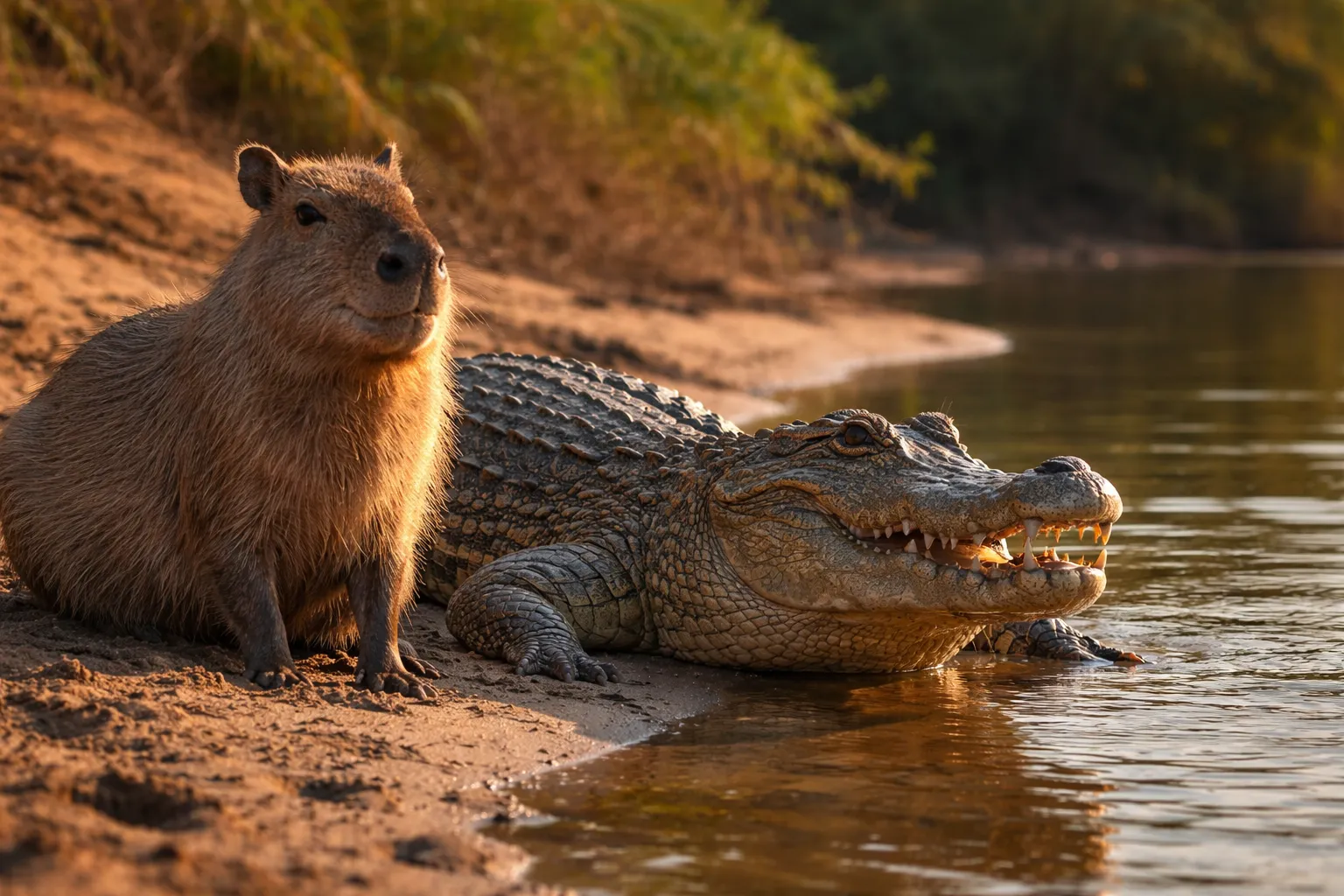
In the wild, survival usually follows a simple rule: bigger animals eat smaller ones. Yet nature often surprises us with unusual relationships that seem to break this rule. One of the most fascinating examples involves crocodiles and capybaras. Photos and videos circulating online frequently show capybaras calmly sitting beside crocodiles, sometimes even resting on their backs. For many observers, this raises an obvious question: why do crocodiles not eat capybaras?
Although crocodiles are powerful predators capable of hunting large animals, the relationship between these two species appears surprisingly peaceful in many cases. Understanding why requires looking at their behavior, environment, and ecological roles.
The Capybara: The World’s Largest Rodent
Capybaras are the largest rodents on Earth and are native to South America. These semi-aquatic animals thrive in wetlands, riverbanks, and marshy regions where water and vegetation are plentiful. They are social creatures that live in groups and spend a large portion of their day grazing on grasses and aquatic plants.
Because capybaras are herbivores and relatively calm animals, they rarely provoke other species. Their peaceful nature allows them to coexist with many animals that share the same habitat. Birds, monkeys, turtles, and even predators are often seen near capybaras without conflict.
Another key factor is their excellent awareness of surroundings. Capybaras are constantly alert to danger, especially when predators are nearby. Their strong swimming ability and quick reflexes help them escape threats by diving into water.
Crocodiles: Powerful but Selective Predators
Crocodiles are among the most efficient predators in the animal kingdom. With powerful jaws, stealthy hunting techniques, and incredible patience, they can capture fish, birds, mammals, and even large animals that come close to the water’s edge.
However, crocodiles do not hunt constantly. Like many reptiles, they conserve energy and feed only when necessary. After consuming a large meal, a crocodile can go days or even weeks without hunting again.
Because of this energy-saving lifestyle, crocodiles tend to attack prey that offers the greatest reward with the least effort. If a potential meal appears risky, difficult, or not worth the energy, the crocodile may simply ignore it.
Habitat Overlap Encourages Tolerance
Capybaras and crocodiles often share the same wetlands and river systems in parts of South America. Since both species rely heavily on water, they frequently encounter each other in the same locations.
Over time, animals that share habitats often develop a kind of natural tolerance. Capybaras recognize when crocodiles are inactive or uninterested in hunting, while crocodiles may see capybaras as familiar animals that do not pose a threat.
This does not mean crocodiles never attack capybaras. In fact, attacks do happen. But in many everyday situations, both animals simply ignore each other and go about their activities.
Capybaras Are Highly Social Animals
One reason capybaras appear so relaxed around predators is their social structure. They usually live in groups that can range from a few individuals to more than twenty animals.
Living in groups provides an important survival advantage. With many eyes watching for danger, capybaras can detect threats early and warn the rest of the group. If a crocodile suddenly becomes active, the entire group can quickly escape into the water.
Their group behavior also means predators often find it harder to target a single animal. This reduces the chances of a successful ambush.
Crocodiles Prefer Easier Targets
In the wild, predators naturally prefer prey that is easier to catch. Fish, birds, and animals that come to drink water without caution are often simpler targets for crocodiles.
Capybaras, however, are strong swimmers and spend a lot of time near water where they can escape quickly. If a crocodile fails to capture its prey on the first strike, the opportunity may be lost.
Because hunting requires patience and energy, crocodiles may wait for animals that offer a higher chance of success.
Viral Photos Can Be Misleading
Many viral photos show capybaras sitting calmly beside crocodiles or other predators. While these images look like examples of friendship, they actually represent brief moments where neither animal sees a reason to attack.
Wild animals behave based on instinct and opportunity. If a crocodile is not hungry, resting, or simply conserving energy, it may tolerate nearby animals without reacting.
However, if circumstances change—such as hunger or a sudden movement—the predator may still attack.
A Balance of Instinct and Opportunity
The peaceful scenes between crocodiles and capybaras highlight how complex animal behavior can be. Rather than constant conflict, many wild animals share space through a balance of instinct, caution, and opportunity.
Capybaras rely on awareness, group protection, and quick access to water for survival. Crocodiles rely on patience and efficient hunting strategies. In many situations, these strategies simply lead both animals to ignore each other.
Nature often operates in subtle ways that challenge our assumptions about predators and prey. The relationship between crocodiles and capybaras is one example of how coexistence can exist even in the wild.
Conclusion
While crocodiles are certainly capable of eating capybaras, they do not always do so. Factors such as energy conservation, prey difficulty, habitat familiarity, and animal behavior all influence whether a predator chooses to attack.
Capybaras have evolved effective survival strategies that allow them to live in environments where dangerous predators are present. Their social nature, alertness, and swimming ability help them avoid becoming easy targets.
In the end, the calm interactions we sometimes see between crocodiles and capybaras are less about friendship and more about the complex balance of survival in nature.